Street Legal & LSV
How to Register and Insure a Street-Legal Golf Cart
The documents you need, the step-by-step DMV process and the insurance options for registering a street-legal golf cart (LSV).
What makes a golf cart street legal in the U.S.: the LSV rules, the required equipment, where you can drive, and how to register and insure your cart.
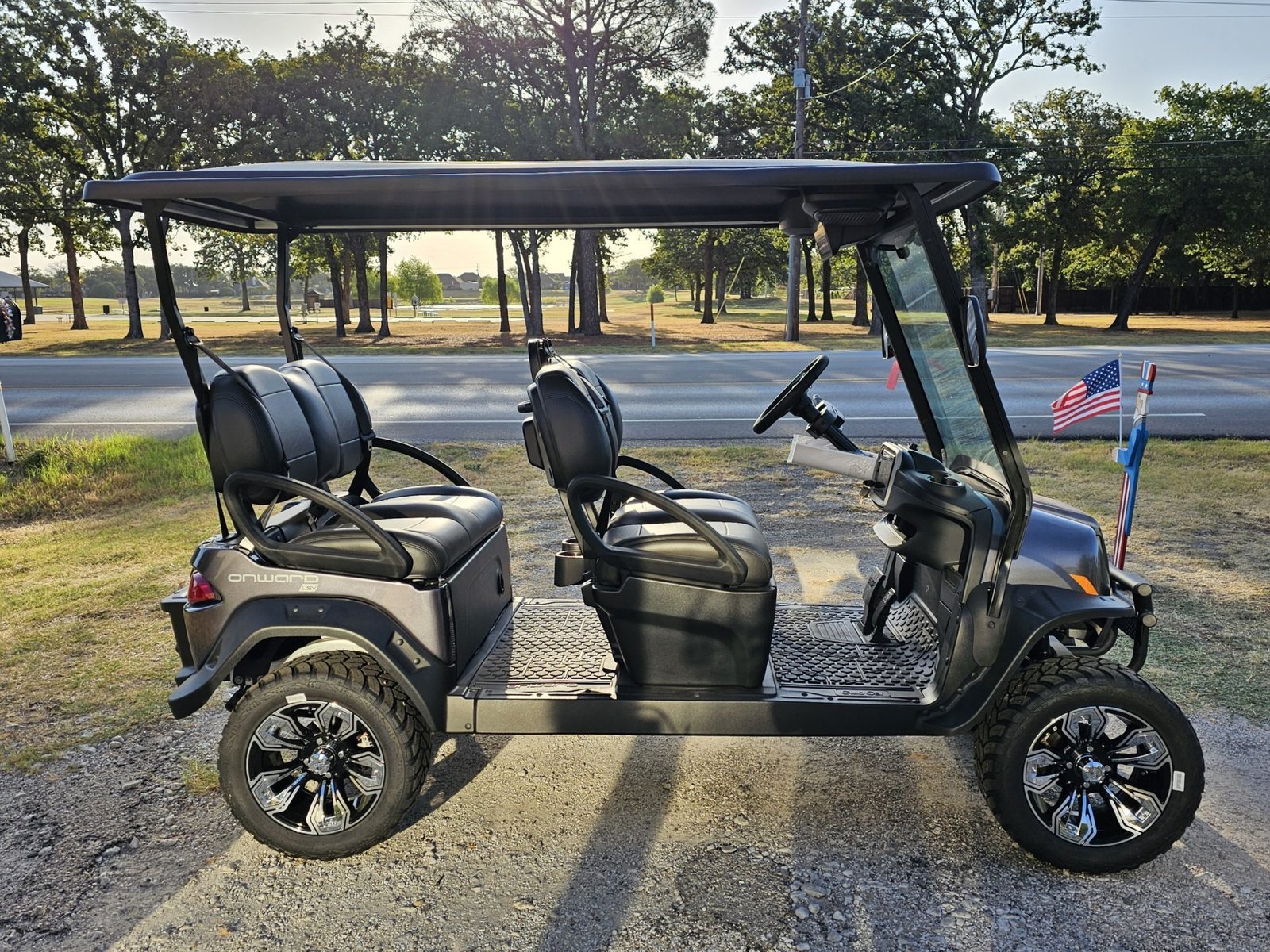
Most buyers who ask us about golf carts want to drive them somewhere: to the beach, the pool, the clubhouse or the store. That means one question comes first: can I take it on the road? This guide explains what makes a golf cart street legal in the U.S., the equipment it needs, where you can drive it, and how to register and insure it.
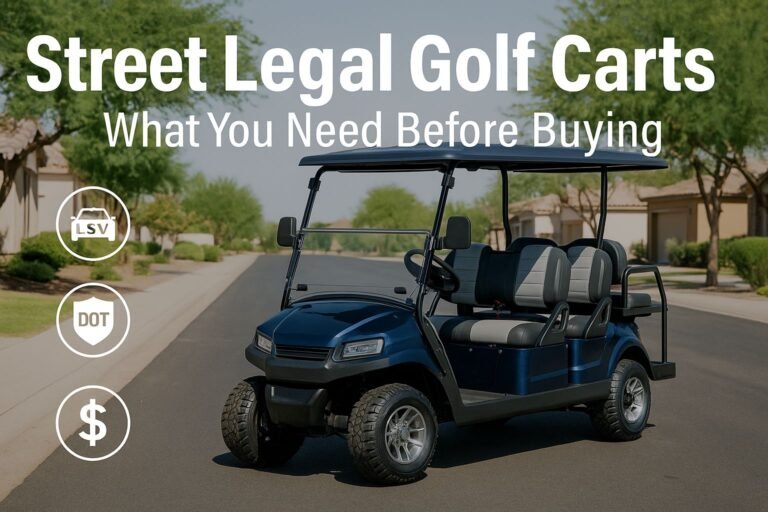
In the U.S., a street-legal golf cart is classed as a low-speed vehicle (LSV). Federal rules define an LSV as a four-wheeled vehicle, other than a truck, that can go faster than 20 mph but no faster than 25 mph, with a gross vehicle weight rating under 3,000 pounds. It must meet Federal Motor Vehicle Safety Standard No. 500, which lists the safety equipment it needs.
A standard golf cart is built for the course. It usually tops out below 20 mph and does not have the equipment or the 17-digit VIN that an LSV needs, so it cannot be titled and registered as a motor vehicle.
| Golf cart | Street-legal LSV | |
|---|---|---|
| Top speed | Usually under 20 mph | 20 to 25 mph |
| 17-digit VIN | No | Yes |
| Safety equipment | Basic or none | Full FMVSS 500 list |
| Title and plates | Not as a motor vehicle | Yes, in most states |
| Public roads | Only where local rules allow carts | Roads posted at 35 mph or less in most states |
| Driver | Local rules apply | Valid driver's license |
Want the full side-by-side, including aftermarket "street legal kits"? Read street legal golf cart vs LSV.
Under FMVSS 500, a street-legal golf cart must come with:


In most states, a registered and insured LSV can use public roads with a posted speed limit of 35 mph or less. Some states also let LSVs cross faster roads at intersections. A few general rules apply almost everywhere:
The steps are similar to registering a car. Exact forms and fees depend on your state. For more detail, see how to register and insure a street-legal golf cart.
Budgeting for the full cost? Registration, taxes and insurance are covered in how much does a golf cart cost.
Some owners add lights and mirrors to a regular golf cart and call it street legal. In many states that is not enough: without a VIN and the manufacturer's certification, the cart can't be titled as an LSV. Some states have their own conversion process with an inspection, but the simplest route is a cart built as an LSV at the factory, with the VIN and paperwork from day one.
The LSV class is a U.S. rule. If you are importing a cart, your own country decides whether and how it can be used on public roads. Ask your local road authority what is needed before you order. We provide the cart's VIN and origin documents, and we confirm the right charger for your country's voltage. See how to buy a golf cart from the USA and ship it abroad for the full process.
Only if it is street legal. In the U.S., that means a low-speed vehicle (LSV) with the required safety equipment and a 17-digit VIN, titled, registered and insured. Local rules also apply.
An LSV must be able to go faster than 20 mph and no faster than 25 mph.
In most states, roads with a posted speed limit of 35 mph or less. Check your state and city rules.
Yes. LSV drivers need a valid driver's license, and the cart needs registration and insurance.
Our golf carts are sold as street-legal models. Cushman industrial vehicles are built for private work sites and are not street legal. Not sure about a specific cart? Ask us before you order.
Yes. We export worldwide. Your country's road rules decide how the cart can be used, so check with your local authority before you order.
Keep reading
The documents you need, the step-by-step DMV process and the insurance options for registering a street-legal golf cart (LSV).
A practical checklist of the equipment a street-legal golf cart needs, the paperwork to keep with it, and the safety checks to run before each season.
It’s the dream, isn't it? You're not just buying a "golf cart"; you're buying a new lifestyle. You're imagining a warm evening,…
Questions about this article?
Tell us what you need and where it's going. We'll reply with the best matches and a delivered price.